Beyond the Shipping Label: Why Growing E-Commerce Brands Are Choosing Dedicated Courier Partners
The rise of self-service shipping platforms was, for a time, one of the most liberating developments in American retail. Suddenly, a small business owner in Des Moines could print a label, schedule a pickup, and ship a product to a customer in Seattle — all without speaking to a single logistics professional. The friction was gone. The barriers were down. E-commerce was, in the most literal sense, accessible to anyone.
But accessibility and reliability are not the same thing. And as the American e-commerce market has grown — now accounting for well over a trillion dollars in annual sales — a meaningful segment of online retailers has begun to recognize that the self-service model, for all its convenience, carries structural limitations that become more damaging as a business scales.
The response, increasingly, is a return to relationship-based logistics: the dedicated courier partnership.
What the Label-Only Model Gets Wrong
Self-service shipping platforms are engineered for volume and simplicity. They are designed to move as many packages as possible through standardized processes with minimal human intervention. For a retailer shipping a hundred orders a month, this works reasonably well. For a business shipping a thousand — or managing premium, time-sensitive, or fragile merchandise — the cracks begin to show.
The core problem is accountability. When a package is dropped into the general stream of a national carrier's network, it becomes one of millions. If it is delayed, damaged, or lost, the process of investigation is slow, documentation is often incomplete, and resolution can take weeks. During that time, the customer is waiting — and growing frustrated with the retailer, not the carrier.
A home goods brand based in Portland, Oregon, experienced this dynamic acutely during a period of rapid growth. As order volumes climbed, so did the company's rate of customer complaints related to delivery. Packages arrived late. Some showed up damaged. A handful simply disappeared. Each incident required the retailer's customer service team to investigate, communicate with the carrier, issue replacements or refunds, and manage the customer relationship — a process that consumed an estimated fifteen hours of staff time per week at peak.
"We were spending more energy fixing delivery problems than we were on product development," the company's operations manager later reflected. "The shipping platform was cheap, but it wasn't actually saving us anything."
What a Dedicated Courier Partnership Actually Provides
The distinction between a self-service shipping platform and a dedicated courier partner is not merely one of price or speed. It is a difference in the fundamental nature of the relationship.
A dedicated courier partner operates as an extension of your business. They understand your product categories, your customer expectations, and the specific requirements of your delivery profile. They provide a named point of contact, not a customer service queue. And critically, they are invested in your success — because their relationship with you depends on it.
In practical terms, this translates to several capabilities that self-service platforms cannot replicate:
Real-time, granular tracking. Rather than checkpoint-based updates that leave long gaps in visibility, dedicated couriers provide continuous location data and proactive communication when exceptions occur. Your customer service team knows where every package is before a customer has to ask.
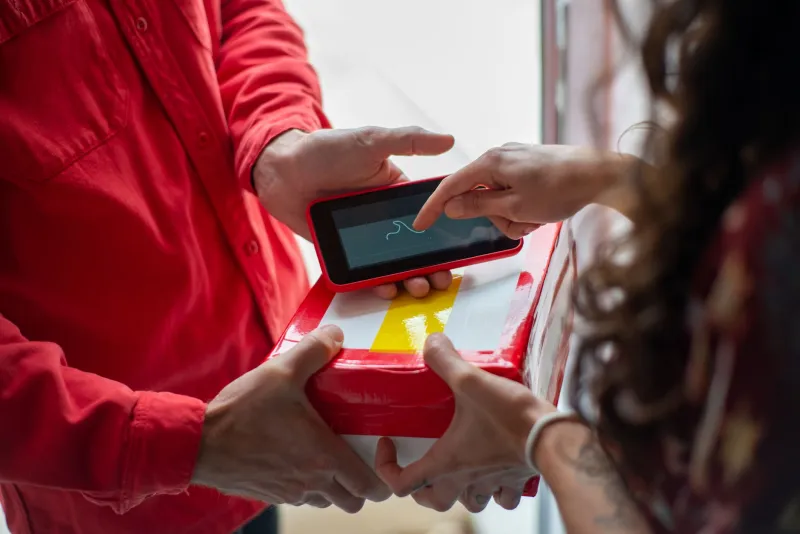
Verified proof of delivery. Signature capture, photographic documentation of the delivery location, and recipient identification verification are standard features of professional courier service. These records are legally admissible and provide critical protection in chargeback disputes.
Liability that reflects reality. A dedicated courier relationship includes negotiated, documented liability provisions that align with the actual value of the goods being shipped — not a generic cap buried in fine print.
White-glove handling options. For retailers selling fragile, premium, or oversized merchandise, dedicated couriers offer specialized handling protocols that general carriers simply do not provide. This means fewer damaged goods, fewer returns, and fewer disappointed customers.
The Chargeback Problem and How Couriers Solve It
For e-commerce businesses, chargebacks — disputes initiated by customers through their payment provider — represent one of the most financially damaging consequences of delivery failures. When a customer claims a package was not received, the burden of proof falls on the merchant. Without documented delivery evidence, the merchant typically loses the dispute and absorbs the cost of both the merchandise and the chargeback fee.
The American chargeback rate for e-commerce transactions has risen consistently over the past several years, with delivery disputes representing a significant and growing share. Industry estimates suggest that merchants lose between $2.50 and $3.50 for every dollar of chargeback value when accounting for merchandise, fees, and administrative costs.
Dedicated courier services directly address this vulnerability. Photographic proof of delivery, recipient signature records, and timestamped delivery documentation give merchants the evidence they need to successfully contest fraudulent or mistaken disputes. Several retailers who have transitioned to dedicated courier partnerships report measurable reductions in their chargeback rates within the first two quarters of making the switch.
Scaling With Confidence
One of the most significant advantages of a dedicated courier partnership becomes apparent during periods of growth — precisely when logistics complexity tends to spike and self-service platforms begin to strain.
A dedicated courier can adapt to your business's evolving needs: adjusting delivery windows, accommodating seasonal volume increases, handling new product categories, and expanding geographic coverage in alignment with your market expansion. This flexibility is built into the relationship rather than requiring you to navigate a new platform, renegotiate terms, or onboard a new provider at an operationally critical moment.
An online pet supply retailer headquartered in Nashville, Tennessee, made the transition to a dedicated courier partner after experiencing significant delivery failures during two consecutive holiday seasons with a self-service carrier. In the first year following the transition, the company reported a 31 percent reduction in delivery-related customer service contacts and an 18 percent improvement in its Net Promoter Score — a metric directly correlated with customer loyalty and repeat purchase behavior.
"Our courier knows our business," the company's CEO noted. "When we have a problem, we call a person who knows us. That's not something you can put a price on — but you can absolutely measure the results."
Positioning Delivery as a Competitive Advantage
In a market where product differentiation is increasingly difficult and customer acquisition costs continue to rise, the post-purchase experience has emerged as one of the most powerful levers available to e-commerce brands. How a customer feels when their order arrives — on time, intact, and delivered with care — shapes their perception of the brand as a whole.
Retailers who invest in secure, reliable, relationship-based delivery are not simply solving a logistics problem. They are building a competitive advantage that is difficult for rivals to replicate through product pricing or marketing spend alone.
At Safe Courier, this is the philosophy that guides every client relationship we build. We do not process shipments. We partner with businesses to ensure that every delivery reflects the standards their customers expect and their brand demands.
The shipping label is a starting point. The partnership is what makes delivery a strength.